In Denton:


In Houston:


More to come from College Station and Kingwood tomorrow, and Laredo on Wednesday.
In Houston:
More to come from College Station and Kingwood tomorrow, and Laredo on Wednesday.
.@ArianFoster If you're actually "in the @GreenPartyUS " then please come to this event in Houston tomorrow night: https://t.co/FO0VTUY4Q6
— PDiddie (@PDiddie) February 22, 2015


According to a CNN/ORC poll taken February 12-15, the Republican field currently ranks in this order, top to bottom: Mike Huckabee (seriously?), Jeb Bush, Scott Walker, Rand Paul, Ben Carson, Chris Christie or None (tie), Marco Rubio, and Someone Else. Then there’s a four-way tie among Ted Cruz, Rick Perry, Rick Santorum and Unsure. Then comes John Kasich, and finally scraping the bottom at 1 percent each are Bobby Jindal, Lindsey Graham and Carly Fiorina. Note that Bush and Christie were numbers one and two a month ago.
He does not return phone calls. He does not ask for support. He arrives late for meetings. And he acts as if he has all the time in the world.The complaints have piled up for weeks, dismaying many longtime supporters of Gov. Chris Christie of New Jersey and sending others into the arms of his rivals for the presidential nomination, according to interviews with more than two dozen Republican donors and strategists.As a half-dozen other candidates aggressively raise money and chase endorsements in Iowa and New Hampshire, friends and detractors alike say Christie’s view of his status and pre-eminence within the Republican field is increasingly at odds with the picture outside his inner circle.
[...]
Some supporters critical of the governor’s campaign blame what they call “the Christie bubble,” a tight-knit group of advisers who have known him for years and have worked for him through most of his tenure in Trenton. Virtually impenetrable to newcomers, this small group is seen as effective at home but also now as shielding him too closely from the realities of a competitive national campaign. Even after the George Washington Bridge lane closings and the resulting scandal, and amid a continuing federal investigation, Christie has not broadly expanded (the number of his closest advisers).
According to the RedState Presidential Power Rankings, Cruz now ranks seven among the top ten potential Republican presidential candidates.

And what about Houston’s large and well-organized LGBT population? “(Chris) Bell has the money gays, Turner has the activist gays,” one observer told me. [...]
Then there are the white power brokers, those guys who used to call the shots. They remember nostalgically the one-call-away days of mayors Lanier and White, particularly the latter, whose Harvard degree, financial acumen, and sophistication seemed so neatly matched with their vision of a modern city on the rise. Torn now between a questionably loyal (Bill) King and a foot-dragging (Stephen) Costello, the bigwigs are turning from disappointment to despair. Their inability to come up with a world-beater of their own is striking.
Put another way, this race has the potential to evolve into something akin to Bonfire on the Bayou, with the city’s diverse factions warring with one another and within their own ranks.
[...]
... (Annise) Parker’s endorsement might be of questionable value. One day she is said to be leaning toward longtime ally Turner, another day toward Councilman Costello, whose practical, just-show-me-the-numbers approach to city government is closest to her own.
Judging from the press, the Marijuana Policy Project's lobby day at the Texas Capitol (this past Wednesday) appears to have gone well. See coverage here, here, here, here, here, here, and here. Much of the coverage mentioned the professional presentation of lobby-day participants in contrast to stoner stereotypes, which is a good sign, though some reporters still can't discuss the issue without giggling. Happily, it sounds from the coverage like Speaker Joe Straus may be open to allowing bills reducing penalties for low-level marijuana possession to get a vote on the House floor. Bills to that effect have cleared committee in the past but never seem to get set on the House floor calendar.
Meanwhile the press, in reductionist fashion, continues to frame most marijuana issues as being about "legalization." However, though a majority of Texans support that, that's not what's at stake this legislative session. Instead, the bill with the most momentum appears to be Rep. Joe Moody's legislation to create a civil penalty for low-level pot possession, a move which would have kept nearly 65,000 people last year from being arrested and taken to jail while still punishing them. Other legislation by Rep. Harold Dutton and Gene Wu would reduce penalties for small amounts to a Class C misdemeanor.
As Grits argued in a recent guest column in the Dallas Morning News, I don't view such bills through a "legalization" lens so much as from a "less government" perspective. Jails are a major driver of county property taxes. And, "If you want to cut the budget in a meaningful, sustainable way, you must identify something government is currently doing that costs money and choose not to do it."
Choosing to stop arresting and jailing pot smokers and paying for their indigent defense costs fits that bill precisely. Bottom line: If you want government to cost less, make it do less stuff. And this is one of those things the Legislature could just let the locals stop doing.

Probably the biggest obstacle to the legalization of medical marijuana is the fear that people might have fun through inebriation. And that got me thinking about how Alexis Bortell and Walmart are sort of the same -- only different. Perhaps I think that because of the $435,000 that Walmart heiress Alice Walton poured into Texas political campaigns last year. I couldn’t find any donations from Alexis or her family. There also is a difference between Alexis and Walmart because the inebriating product Walmart is pushing in this year’s Legislature already is legal.
[...]
I don’t want to argue for or against legalizing marijuana or medical marijuana. But I do want to ask the question: Why can’t Alexis get some tender loving care and some THC if Walmart gets its package stores?
“I have been talking to a number of members that feel like this is a way to separate those that want to see the therapeutic benefits of the substance without the potential for abuse,” said Klick, who is a registered nurse. “As is, [these oils] have no street value and no psychoactive effect. If we bump that ratio up, I think we will lose support.”
Klick said there will also be a loss of political support if her bill is expanded to include other ailments, such as cancer, Crohn's disease or Lou Gehrig's disease.[...]As the bill is written, it stands to lose the support of Alexis Bortell, whose story has made national news and struck an emotional chord in Texas. In 2013, when Alexis was 7, she had her first seizure in the family's home in Rowlett, near Dallas. Since then, doctors have struggled to find medication that would offer her relief.“As the legislation is written now, Alexis would only be able to use CBD if we could show that there were no other FDA-approved treatments available to her,” said Dean Bortell, a U.S. Navy veteran and computer programmer. “That means trying several dangerous pharmaceuticals that she has already had a bad reactions to. The second one she tried she had trouble with, and we were far below the maximum dosage.”

In what one local union official is calling a new brand of aggressive strike-breaking tactics, energy companies are trying to lure employees back to work by going around the United Steelworkers union.
BP issued a statement Wednesday that it has begun to train additional replacements for its absent workers while Lyondell-Basell posted an open letter to its striking employees asking them to return to work.
Shell Oil Co. is also asking workers at its Deer Park refinery to cross the picket line. About 50 out of the 800 strikers have done so, said Lee Medley, president of the United Steelworkers Local 13-1.
In the third week of a nationwide oil workers strike, the targeted companies are playing hardball, said Medley, who could not recall another time when companies so openly courted their striking employees. He said the union is contemplating the filing of an unfair labor practice charge against Shell for directly contacting its striking employees.
"The steps they're taking are not novel," said Robert Bruno, professor at the School of Labor & Employment Relations at the University of Illinois at Urbana-Champaign.
What's unusual, he said, is how quickly the effort began. That tells Bruno that the strike is causing pain for the oil companies. It may be they can't continue to operate with the labor they have or they can't get the production they need, he said. They may believe they have to go on the offensive.
Over the past few days, companies that specialize in staffing refineries and chemical plants during labor disputes have been advertising in Houston for experienced control room operators.
Madi Corp., for example, has an online job posting offering $48 an hour, plus $40 per day for expenses, along with free hotel and airfare for experienced oil refinery console operators in Houston. Operators are guaranteed a minimum of 60 hours a week but are expected to work 84 hours a week.
"Shift the power to your side of the negotiating table during contract negotiations with your unions," the company's website beckons to employers. It says it can place the "right strike replacement workers in the right jobs" in 24 to 72 hours.
Union negotiators on Thursday rejected the latest contract offer from oil companies and said the largest U.S. refinery strike since 1980 may spread to more plants beyond the 11 where walkouts are underway.
The United Steelworkers union (USW) said in a message to members and news media including Reuters that the latest proposal from lead oil company negotiator Royal Dutch Shell Plc failed to improve safety at refineries and chemical plants in an "enforceable way."
The union also told workers not on strike to be prepared to walk out in the coming days.


Cargo companies have gone straight to West Coast dockworkers with what they call their "last, best and final" offer in a contract crisis that has choked off billions of dollars in international trade.
In a move very likely to upset union leaders who were negotiating behind closed doors under a media blackout, the employers distributed letters with the contract offer to rank-and-file longshoremen at ports from Los Angeles to Washington state.
Employers appear to hope that union members will conclude the offer — which the letter said includes wage and pension increases and the maintenance of low-cost health benefits — is strong, and dockworkers will then pressure their negotiators to accept it.One labor expert questioned whether that would work, especially with the International Longshore and Warehouse Union, which has a history of fighting employers and winning contracts that are the envy of other blue-collar industries. Under the prior contract, which expired in July, average wages exceed $50 an hour, according to the maritime association."Handing out the leaflets is a provocative move with questionable gain," said Harley Shaiken, a professor and labor relations expert at the University of California, Berkeley. "We're in the end game, and you don't want to complicate things, and that is the risk."The letter's "last, best and final offer" language is significant because it could lay the groundwork for the declaration of an impasse and therefore a full lockout of workers by employers.Meanwhile, negotiators for the union and the Pacific Maritime Association, which represents employers, met with U.S. Labor Secretary Thomas Perez in San Francisco.
The involvement of the nation's top labor official underscored rising political and economic pressure to reach a contract deal and free cargo bottlenecks at 29 ports that handle about $1 trillion of trade annually. Commerce Secretary Penny Pritzker also attended sessions Wednesday.
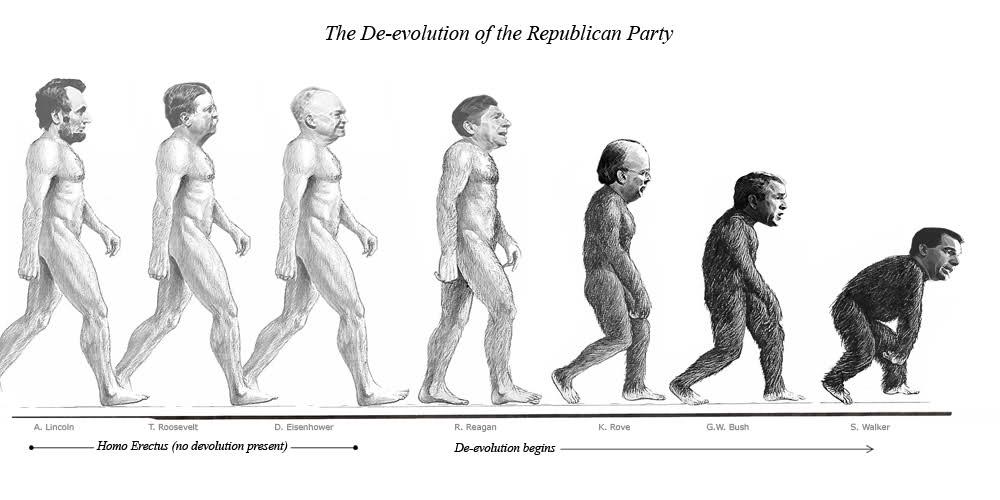
In the wake of Dave Fahrenthold's great piece about Scott Walker's college years, Democrats have begun to openly question the Wisconsin governor's ability and readiness to be president, given that he doesn't have a college degree.
[...]
This seems to me to be a MAJOR strategic mistake that could badly backfire on Democrats if Walker happened to become the Republican nominee in 2016. Here's why...
Jim Newell argues at Salon that it's a bad idea for Democrats to attack Scott Walker for not having a college degree. As I said last week, I agree -- it comes off as elitist and condescending, in a country where most people don't have a boatload of degrees from fancy schools and aren't quite sure what they think about people who do. I think many voters who hear attacks like this will feel they're being personally insulted. It's a bad move.
And now we have this, from Olivia Nuzzi at the Daily Beast, and I really hope no Democrat tries to follow up...
[...]
The story smells like opposition research fed to a journalist -- but by whom? It could be the Clinton campaign, but it could just as easily be the campaign of a better-traveled Republican, or it could be an organization on the right that's determined to prevent the insufficiently hawkish Paul from winning the nomination. Nuzzi's story certainly lists a lot of travel by a number of Paul's likely primary competitors:
We need to take the stigma away from those who choose not to go to college, and we also need to emphasize community college for those who need more education, but not a four-year program. But it’s also not unreasonable to expect that our political elite -- and there’s nothing more elite than being president of the United States -- have a semi-elite level of formal education.
See, to conservatives, "college" is itself a signifier of "indoctrinated into leftist beliefs." And, of course, "college" only means the Ivy League. Says (Instapundit's Glenn) Reynolds, after listing the Harvard, Yale, et al credentials of President Obama and the Supreme Court, "All this credentialism means that we should have the best, most efficiently and intelligently run government ever, right? Well, just look around. Anyone who has ever attended a faculty meeting should recognize that more education doesn't produce better decision makers, and our educated mandarinate doesn't seem to have done much for the country." Serious question: Is Reynolds a total cock at his own faculty meetings? And the Rude Pundit has long believed that Ivy League incest has harmed the nation. But the solution is not to say, "Well, obviously, college makes people dumb." It's to say, "Hey, how about some leaders who came from state schools?"
As the Rude Pundit has said before, if you believe that colleges are merely bastions of bolshevik liberalism, spend some time with professors in the business majors or, really, the STEM profs. Oh, wait. They believe in science, so maybe not.
As for Scott Walker, let's dismiss his inability to answer a question about evolution as craven political expedience. What does matter is, as governor, he has bought into the right-wing attack on higher education and he wants to fuck the universities of his state with huge budget cuts, just like Bobby Jindal in Louisiana. That shit looks sketchy, especially when you don't have a degree.
If you can be successful at something without a diploma, good on you, future Bill Gates or Louis CK or Oprah. Obviously, people can be just like you. Except for the almost everyone who can't.

The public would know a lot more about which lawmakers are getting wined and dined under legislation filed Monday by state Sen. Kirk Watson, D-Austin.
Watson filed three bills that would effectively shut down a giant loophole that allows lobbyists — often under pressure from legislators — to avoid naming names when they fill out their mandatory spending and entertainment reports with the Texas Ethics Commission.
Watson said he’s not casting “aspersions” on anyone but hopes his legislation will increase public confidence in state officials as they interact with lobbyists representing various interests at the Capitol. State Rep. Charlie Geren, R-Fort Worth, has filed similar legislation, but Watson's bills take the concept a few steps further. They extend the reporting requirements to spending on relatives of state officials while building in protection against future loopholes.
“Anything we can do to assure confidence in that and assure that it’s being done in the appropriate way, we should,” Watson said. “And that is generally best served by better reporting, better disclosure and more knowledge.”
House Speaker Joe Straus became the legislative Border Patrol last week, tapping the brake when Lt. Gov. Dan Patrick proposed booking the National Guard for an extended stay on the Texas-Mexico line.
[...]
Patrick wants to put in $12 million to keep those troops in place until May, which would give him time to push for a longer deployment during the legislative session.Straus called him on it, saying in effect that only Gov. Greg Abbott, as the state’s commander in chief, has the power to play army.
[...]
Abbott has not said anything about the arm-wrestling, at least in public.
This tension is not just about the border thing.
In an interview with James Henson, a Texas Tribune pollster and head of the Texas Politics Project at the University of Texas at Austin, Straus added to the list that starts with border security. He said there are questions to resolve about blocking colleges’ bans on concealed handguns and opposes the repeal of in-state tuition for certain children of undocumented immigrants. That puts him at odds with Patrick on those issues. During the weeks ahead, we all get to find out whether the House and the Senate are taking the same positions as their leaders on those issues.
But it’s not just about issues, either.
Virtually all voters educate themselves on candidates at the top of the ticket (president, governor, etc.). But many voters, partially because of straight-ticket voting, make little or no effort to educate themselves on the candidates at the bottom of the ticket running for offices that have the most direct effect on individual citizens — think county clerk, county commissioner, justice of the peace and state representative. These voters simply check the one box, either Democrat or Republican, and move on without giving it a second thought.
This is bad for Texas.
Let me give you just one example. My Democratic opponent last year was the vice presidential candidate for the Socialist Party USA in 2012. In our race, he put forth little effort to inform voters about himself or his platform. However, on Election Day he received about 35 percent of the vote — almost identical to the percentage of the vote that Democratic gubernatorial candidate Wendy Davis received in the district. Even I, a conservative Republican, don’t believe that 35 percent of Democrats in my district are Socialists or believe in what Socialists believe. But the way they voted in November tells a different story.
The answer to this is to join the 39 other states in the U.S. that have no straight-ticket voting. Voters will still be able to vote a straight-party ticket, but they’ll have to take a little extra time to go step by step down the ballot and select a candidate for each elected office. This will hopefully encourage voters to learn about the candidates in each race. But even if voters choose not to educate themselves, they can still vote along party lines or decide to not vote for any candidates in a particular race.
Are our liberty and way of life not important enough to really know whom we’re voting for to run our local and state governments? If people don’t make the effort, those who want to deceive, manipulate and abuse our representative form of government for their gain will be the only ones left standing in our halls of government.
I’ve filed House Bill 1288 to eliminate straight-ticket voting in Texas. I encourage you to contact your state representative and state senator to request their support of this legislation.
State Rep. Jason Villalba has filed legislation that would exempt judges and county officials from straight-ticket ballots.
The bill relates to elections in Texas’ largest counties, including Dallas County. The offices of sheriff, district attorney, tax assessor and constable would be removed from party-line voting. Criminal and civil court judges would also be exempt.
“We need to get away from straight-ticket voting and focus more on qualifications, criteria and ability, rather than party affiliation,” Villalba said.
[...]
Villalba, R-Dallas, said he prefers removing all “non-policy making elected offices” from partisan elections, but that would take a Constitutional referendum.
“If we thought we could get a Constitutional Amendment passed, that’s the direction we would go,” Villaba said.
As it stands, Villabla is unlikely to get this bill through the Legislature. Most Democrats and Republicans like the current system.
“It will be a tough one,” Villalba said.
-- Relief is delayed for millions of people
Here's what this means: Until this ruling is reversed or a different ruling comes down in the future, the federal government isn't allowed to do anything to implement either of the new programs President Obama announced in November to protect unauthorized immigrants from deportation.
Between the two programs, millions of immigrants were supposed to be eligible for deferred action (three years of protection from deportation) and work permits. Neither of those programs had actually started accepting applications yet, although one was supposed to start on Wednesday. Now they won't be able to start until further notice.
[...]
-- Why this is a serious threat to Obama's immigration policy
[...]
When the administration created the first deferred-action program in 2012, for young unauthorized immigrants, they discovered the success of the program relied on people signing up — and on the ground, organizers learned that finding eligible immigrants and getting them to apply was the hardest part. Now, community groups are trying to educate a much larger, more diffuse immigrant population about the new deferred-action programs, and persuade them that it's safe to apply. But news and misinformation about the lawsuit is spreading confusion and fear among the very people these groups are trying to reach.
Organizers are worried about a "chilling effect": by the time applications do open for deferred action, immigrants will have been intimidated out of applying, because they won't believe the program is safe or permanent.
-- Does this mean Obama's executive actions have been found unconstitutional?
No. The reason that Judge Hanen is stopping Obama's actions actually isn't about the Constitution at all. As Josh Blackman, a professor at the South Texas College of Law who filed a brief on behalf of the states in this case, says, "Generally, courts will not reach the constitutional question unless they need to."
Instead, Hanen's ruling is about a procedural law called the Administrative Procedures Act, and in particular the "notice and comment requirement" which is the typical procedure for making federal regulations. According to Cecilia Wang, Director of the Immigrant Rights Project for the ACLU, Hanen's ruling says that "if (the government) wanted to do these things it should have provided notice in the Federal Register, with period for comment." But because the Obama administration didn't do that for these actions, the ruling says, it violated the law.
Furthermore, this isn't even Judge Hanen's final opinion on the matter. This ruling is an injunction: it means that while Judge Hanen hasn't decided whether or not the president's executive actions are unconstitutional or illegal, the government has to stop acting on them while the judge makes up his mind.
[...]
-- What happens next?
At this point, it's up to the Department of Justice to decide whether they want to ask for a stay — basically, something to enjoin the injunction. They're (obviously) expected to do that. Then it'll be up to the Fifth Circuit to consider the stay. If they side with the federal government, the program will start running again; if they shoot down the federal government again, implementation will have to wait.
The ruling on the stay will determine whether or not the president's policies move forward for the next several months. During that time, the Fifth Circuit will be considering whether to uphold Judge Hanen's injunction. That could take four to five months, if they fast track the case, or seven to eight months if they don't. At the end of that time, they'll have another opportunity to stop the program or restart it: even if they grant the government a stay this winter, if they uphold Judge Hanen's ruling later in the year, the government has to stop again.
Meanwhile, Judge Hanen himself still has to issue his final ruling on whether or not the executive actions were constitutional.
-- The Silver Lining
Ironically, however, the fact that Hanen’s opinion casts a cloud of doubt over the legality of DACA (Deferred Action for Childhood Arrivals) may be its most hopeful sign for undocumented immigrants. The Arizona decision did not simply emphasize the executive branch’s “broad discretion” over many immigration-related matters, it was handed down just days after Obama announced the DACA program. Indeed, Justice Antonin Scalia railed against DACA in his opinion dissenting from the majority in Arizona.
If a majority of the justices found DACA legally problematic, it would be very unusual for them to emphasize the scope of the executive branch’s discretion just days after President Obama announced the DACA program. It would be even more unusual for them to do so when one of their brethren specifically criticized that policy in dissent.
The fact that Hanen’s logic appears to extend to DACA, in other words, may be Hanen’s undoing. A majority of the Supreme Court, including two of the Court’s Republicans, have already hinted that Hanen’s opinion is wrong.