

But they're not racists.


Poll: Grimes leading McConnell in Kentucky


Twice Phillips’ Oilers battled the Pittsburgh Steelers for a berth in the Super Bowl, and both times they came up short. After each loss, they were welcomed home by more than 40,000 cheering fans at the Astrodome, inspiring one of the most famous quotations in the history of Texas sports.
“One year ago we knocked on the door. This year we beat on the door,” Phillips said after the 1980 title-game loss. “Next year we’re gonna kick the sumbitch in.”
[...]
Of the first of the two mammoth Dome pep rallies, Phillips said, “Don’t forget all those people standing along the road when we were driving in. There must have been a hundred thousand of them out there. And we’d lost the damned game. I’ll take that memory to my grave.”
This is very artfully done. When I first read this I assumed it meant that Houston ran ahead of President Obama in Texas. In fact, he did get a slightly higher percentage of the vote - 45.88 percent to 43.68 for Obama. But his vote total - 3,525,141, lagged ever-so-slightly behind Obama's 3,528,633. But Angle's statement is perfectly accurate because Houston did win more votes than any other "Texas Democratic candidate," because neither Barack Obama nor Joe Biden is a Texan.
State Rep. Dan Branch announced Thursday his proposal to create a Voter Fraud Task Force if elected as Attorney General.
“I have a clear plan to attack voter fraud in Texas,” Branch, R-Dallas, said in a press release.
Branch said the task force would:
”closely monitor the activities of groups that would seek to subvert ballot integrity
appoint a Special Counsel devoted to exposing and prosecuting any instance of voter fraud, and
aggressively defend the landmark Texas voter ID law from the Obama Administration’s spurious attempt to invalidate it.”

“The bottom line is the government shutdown has hurt the U.S. economy,” Standard & Poor’s said in a statement. “In September, we expected 3 percent annualized growth in the fourth quarter because we thought politicians would have learned from 2011 and taken steps to avoid things like a government shutdown and the possibility of a sovereign default. Since our forecast didn’t hold, we now have to lower our fourth-quarter growth estimate to closer to 2 percent.”
Moody’s Analytics reported a similar number Wednesday, saying by the end of the day the shutdown will cause a $23 billion hit to U.S. GDP or $1.4375 billion per day.
-- $3.1 billion in lost government services. Although furloughed workers will get their back pay, taxpayers won’t see the products. (Source: I.H.S.)
-- According to the U.S. Travel Association: There has been $152 million per day in all spending related to travel lost because of the shutdown. As many as 450,000 American workers supported by travel may be affected.
-- According to the National Park Service: They welcome more than 700,000 people per day usually in October and visitors spend an estimated $32 million per day impact in communities near national parks and contribute $76 million each day to the national economy. Those revenues were lost.
-- According to Destination D.C., the official tourism corporation of D.C.: There is a 9 percent decrease in hotel occupancy from the last week in September before the shutdown to the first week of October during the shutdown. This year, hotel occupancy was down 74.4 percent for the week Sept. 29 to Oct. 5 compared to the 2012 numbers. (Source: Smith Travel Research, Inc.) In 2012, an estimated $6.2 billion of visitor spending supported more than 75,300 jobs.
- The net cost of to the government from the Troubled Assets Relief Program (TARP): $24 billion
- The Department of Agriculture’s proposed budget: $22.6 billion
- NASA’s approved budget: $16.6 billion
- All air transportation programs, including the Federal Aviation Administration, security, research, and other costs: $21.9 billion
- The Child Tax Credit: $22.1 billion
- The Temporary Assistance for Needy Families (TANF) program (formally known as welfare): $17.7 billion
- The cost of Head Start, the Children’s Health Insurance Program (CHIP), and Women Infants and Children (WIC) program combined: $25.2 billion
The topline figure may not take many other costs into account, such as loans that didn’t go out from the Small Business Administration, permits that got held up, and the loss of billions in tax revenue. Plus the government could still get a downgrade on its credit, which could ding business and consumer confidence and bring about more costs.
The shutdown was just the latest budget crisis that has been costly to the economy. A recent report found that the uncertainty created by fights over funding the government and raising the debt ceiling that have cropped up since 2010 has cost the economy nearly a million jobs.
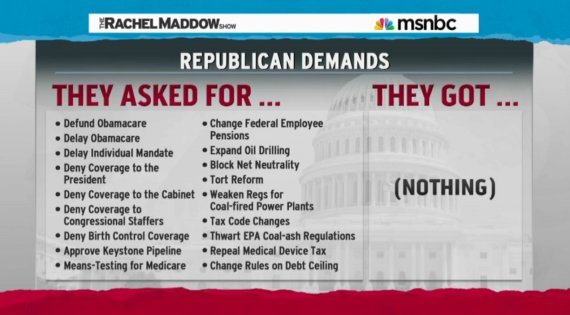
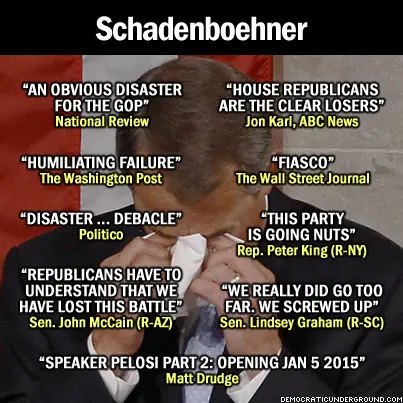
His eyes welling up with tears, Sen. Cruz said, “I embarked on this crusade with a simple goal: to keep affordable health care out of the reach of ordinary, hard-working Americans. And while this battle was lost, that dream—that precious, cherished dream—will live on.”
Reflecting on the government shutdown and near-default that almost touched off a global financial apocalypse, Sen. Cruz said, “We’ll give it another try in a few weeks.”
Sen. Cruz’s closest ally, Sen. Mike Lee (R-Utah) also spoke reverently of the shutdown, calling it “the most expensive Civil War re-enactment in history.”
“Unfortunately, once again, the wrong side won,” he said.
Over in the House of Representatives, Speaker John Boehner (R-Ohio) congratulated his colleagues on the deal to resolve the shutdown, telling reporters, “This proves that when we work together, we can come up with a totally unsatisfactory solution to a completely unnecessary crisis.”


A new Gallup poll shows 60 percent of Americans think the Democratic and Republican parties have done a poor job of representing the people during the government shutdown. They think a third major party is needed.


Texas Rep. Steve Stockman, R-Friendswood, has recently backed a bill to require federal officials to comply with state marijuana laws, which was introduced in April and has since garnered support from Congressmen on both sides of the aisle.
The Respect State Marijuana Laws Act of 2013, introduced by California Rep. Dana Rohrabacher, a Republican, would bar federal drug enforcement agents from penalizing any person abiding by the marijuana laws in their own state.
The law “shall not apply to any person acting in compliance with State laws” — that is, people who are in compliance with their state laws regarding possession, manufacture or use of marijuana will not be subjected to federal penalties.
On an annual basis, no state arrests and criminally prosecutes more of its citizens for pot than does Texas. Marijuana arrests comprise over half of all annual arrests in the Lone Star State. It is easy to see why. In 2009, more than 97 percent of all Texas marijuana arrests — over 77,000 people — were for possession only. Those convicted face up to 180 days in jail and a $2,000 fine, even upon a first conviction.
Despite Texas’ dubious distinction as the #1 pot prosecuting state in America, police and lawmakers have little interest in exploring alternatives. In 2007, Gov. Rick Perry signed legislation (HB 2391) into law granting police the option of issuing a summons in lieu of an arrest in minor marijuana possession cases. Yet aside from police in Austin, long considered to be the state’s lone bastion of liberalism, law enforcement have continued to fervently make arrests in even the most trivial of pot cases.
In 2011, Houston Democrat Harold Dutton introduced House Bill 458, which sought to reduce penalties for the adult possession of one ounce or less of marijuana to a Class C misdemeanor, punishable by a fine not exceeding $500 and no criminal record. Within weeks, over 2,500 Texans contacted their House members in support of the measure. Nonetheless, House lawmakers refused to even consider bringing the measure to a vote.

In the landmark case of District of Columbia v. Heller, Cruz drafted the amicus brief signed by attorneys general of 31 states, which said that the D.C. handgun ban should be struck down as infringing upon the Second Amendment right to keep and bear arms. Cruz also presented oral argument for the amici states in the companion case to Heller before the United States Court of Appeals for the District of Columbia Circuit.
In addition to his victory in Heller, Cruz has successfully defended the constitutionality of Ten Commandments monument on the Texas State Capitol grounds before the Fifth Circuit and the U.S. Supreme Court, winning 5-4 in Van Orden v. Perry.
Cruz authored a U.S. Supreme Court brief for all 50 states successfully defending the recitation of the Pledge of Allegiance in public schools, winning 9-0 in Elk Grove Unified School District v. Newdow.
Cruz served as lead counsel for the state and successfully defended the multiple litigation challenges to the 2003 Texas congressional redistricting plan in state and federal district courts and before the U.S. Supreme Court, winning 5-4 in League of United Latin American Citizens v. Perry.
Cruz also successfully defended, in Medellin v. Texas, the State of Texas against an attempt by the International Court of Justice to re-open the criminal convictions of 51 murderers on death row throughout the United States.
In his ongoing gambit to claim Greg Abbott’s record as his own, Ted Cruz has opened up his record to intense scrutiny from Texas voters.
It has been revealed that Cruz as a bureaucratic lawyer severely mishandled a court case that would have expedited justice and punished child rapists with the ultimate penalty.
The Texas Legislature passed “Jessica’s Law,” which imposes the death penalty on certain child rapists. Several states joined Texas in calling for justice, and liberals sued, claiming the laws were unconstitutional.
Greg Abbott told Ted Cruz to defend the law before the Supreme Court, but Cruz completely failed to perform elementary research surrounding the death penalty, and Texas’ law was rejected.
"The oversight became the basis of an unsuccessful effort to get the Supreme Court to rehear the case. The request for rehearing noted that the oversight was a ‘significant error.’"Cruz’s “significant error” caused the Texas law to be defeated, and tougher penalties for child rapists were dismissed.
Cruz doesn’t mention this embarrassing error when he gives speeches. He instead ignores his failures and claims credit for Greg Abbott’s leadership. In fact, he won’t even publicly admit that his appalling incompetence during the case had any significance.
"At the time, however, Cruz was concerned that a New York Times reporter might write that the office of the solicitor general ‘screwed up by not finding (the military provision)’…"Official correspondence from a defeated Ted Cruz illustrated his attempt to hide his malfeasance.
"Would love to have some sort of response so we don’t look silly," Cruz wrote to a lawyer in the attorney general’s office.
"First let me say that your job must be awfully tough right now and I sympathize with you, particularly as your boss is trying to take away your employer-provided health care. That said, I want to thank Mr. Culberson for the excellent work he is doing for the Democratic Party. A month ago there was no hope that Democrats could retake the House, but thanks to the work done by he and the other Tea Party caucus members, there are now 24 Congressional districts that have moved from 'likely Republican' to the toss-up category. Please pass on my gratitude and tell him to keep up the good work."
"The better Wendy does, the better we will do," (Friedman) said. "And we will also be able to bring a lot of independent voters and people who have never voted before."
Friedman, who describes himself as "an old time Harry Truman Democrat," had been mulling a gubernatorial bid. He previously expressed interest in promoting the legalization of marijuana and casino gambling in Texas. On Saturday, he said that the two issues would remain a part of his platform as a candidate for ag commissioner, especially the idea that the state should "legalize, cultivate, tax and regulate marijuana."
"It could be an economic engine for the state, enabling us to do whatever we want to do," he said.
Friedman acknowledged that he is not currently an expert on major issues such as water policy, nor is he much of a bureaucrat. But like Jim Hightower, the state's last Democratic agriculture commissioner, he said he hoped to expand the scope of the state's Department of Agriculture to bring attention to issues he feels are important. "I would like to do something for rural Texas," he said, adding that he also hoped to reach out to people who currently felt left out of politics.
