



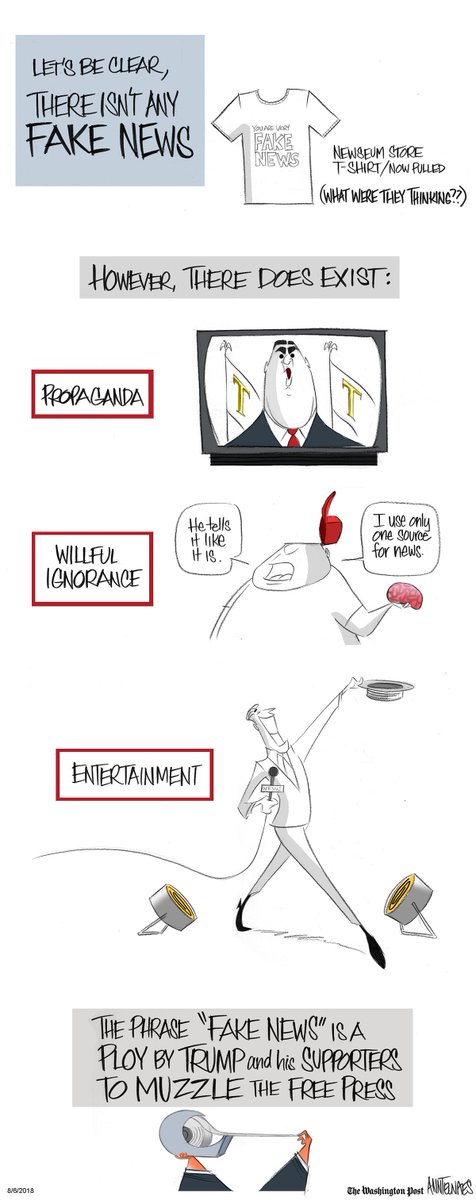
The editorial board of the Boston Globe is proposing that newspapers across the nation express their disdain for the president’s rhetoric on Aug. 16 with the best weapon they have: their collective voice.



"Bipartisan Agreement" flavor is back!


The editorial board of the Boston Globe is proposing that newspapers across the nation express their disdain for the president’s rhetoric on Aug. 16 with the best weapon they have: their collective voice.
“Officials said that the ban was an “attack on workers” in the fossil fuel industry”. Seriously. That’s their argument.— #ThereIsNoPlanetB 🌍 (@RosettaDrone) August 11, 2018
Oh, @DNC, you really are a bunch of corporate a-holes.
Democrats repeal party's ban on fossil fuel donations after two months https://t.co/lWGD2MEght
The strength of the fossil fuel donations ban seemed in question almost immediately after it passed. The DNC refused to announce the resolution, declining to comment to HuffPost for a story that made the vote public.
At the Texas Democratic Party’s convention two weeks later (this past June), a state party official opposed a state-level proposal to ban fossil fuel donations and oppose new gas extraction, arguing that the DNC’s own resolution was not set in stone.
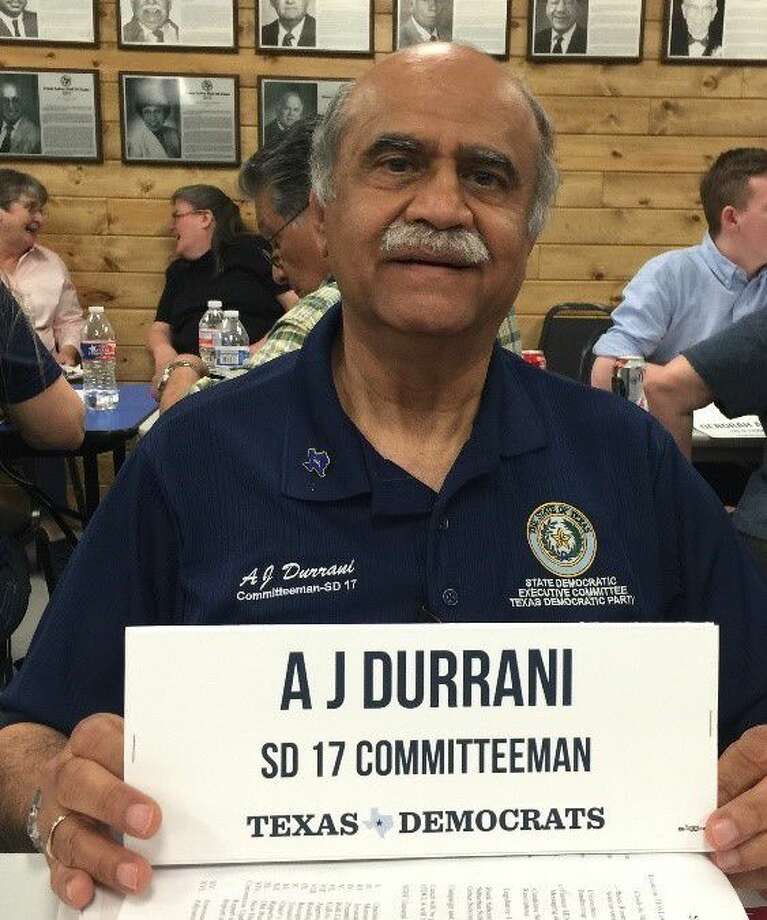
A.J. Durrani, a retired engineer and manager at the oil giant Shell who recently joined the national party committee, said the DNC did not include the earlier vote in the minutes from its last executive committee meeting.
“There was no mention in it,” Durrani said by phone in June. As far as he was concerned, he said, “As of right now, the DNC has not voted.”
Durrani did not immediately respond to a request for comment on Friday.
Texas Democrats ultimately voted down their proposed resolution.
The DNC's proposal to lift the ban on accepting donations from fossil fuel companies is premised on the party's support for unions. As of 2017, just 4.4 percent of workers in the mining sector -- including coal, oil and gas -- were union members (via https://t.co/1Ao6HRNKFk) pic.twitter.com/MdQWfp90n7— Kate Aronoff (@KateAronoff) August 10, 2018
My hunch would be that this came from (among others) higher-ups at the IBEW, which has donated $305K to the DNC this cycle https://t.co/JI6idJx3q6— Kate Aronoff (@KateAronoff) August 10, 2018
We have an unfortunate tendency in America to treat racism and racial resentment as a pathology of the white underclass. Takes about the need for Democrats to abandon woke “identity politics” typically cite a desire to win back the “white working class,” not white members of the Harvard Club.
But while there’s some survey data backing the idea that working-class whites are likelier to harbor racial resentment (see table 3 here), the racism that kept Jews and blacks out of country clubs (and out of Harvard) for generations is still around. And Kobach is a great example of how it can continue to have real political consequences.
Kobach isn’t alone. White House adviser Stephen Miller didn’t have a Huntington figure during his time at Duke; in all the profiles written about Miller, I’ve yet to find one that mentions a professor who mentored him or even liked him. But it was Miller’s role as a conservative voice on campus during the Duke lacrosse scandal (a scandal that became a national affair only because of Duke’s elite status) that catapulted him into a career as a policy aide on Capitol Hill, and now in the White House. He, like Kobach, leveraged elite credentials to implement racist policies.
Further on the fringes of American life, Richard Spencer’s time as a Duke grad student, and Jared Taylor’s Yale pedigree, have helped lift them from obscurity into being commonly cited voices from the “race realist” movement. They got a patina of respectability, a sense that they’re a different, higher class of racist.
Working-class white racists can inflict a lot of harm; hate crimes in this country are a real thing, committed by people with all kinds of income and education levels. But economically unprivileged whites typically don’t cause damage on the scale of Miller or Kobach — or even Spencer or Taylor. That escalation requires elite credentials and connections.
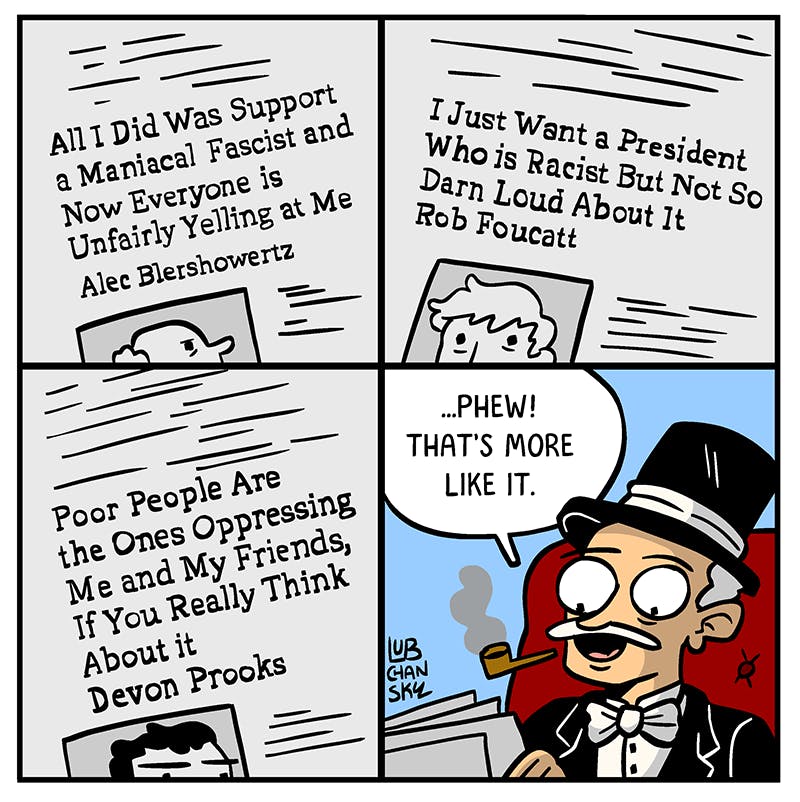
... I hope Kobach can help change our mental image of an American racist from lazy stereotypes of manual laborers to a Yale-trained lawyer with a PhD, whose racial views come in part from a celebrated Harvard professor. That’s the bigger danger.
Culberson says his interest in Innate was sparked by "press reports," though he has declined to specify which ones. News reports in January -- just before he and Conaway bought Innate stock -- focused on the controversy surrounding the purchase of shares at discounted prices by Collins and then-Georgia U.S. Rep. Tom Price, now (formerly) the secretary of health and human services.
An article in the New York Times in early January, two weeks before Culberson bought his stock, hardly inspired confidence. It described Innate as "a tiny pharmaceutical company from Australia that has no approved drugs and no backing from flashy venture capital firms." The piece also noted that the company had run out of money "more than once" and nearly folded.
On Capitol Hill, the focus was on Collins, who was being accused by Democrats of promoting Innate stock to colleagues in the halls of Congress. Collins has repeatedly denied the charge.
Earlier this month The Hill, a Capitol Hill newspaper, published an "exclusive" report citing a half-dozen Republican lawmakers -- all speaking anonymously -- who said they heard Collins "talking up" Innate at various congressional gatherings.
Again, Collins denied it, telling The Hill, "I've never encouraged anyone to buy the stock. Ever."
A number of ethics watchdog groups and legal analysts say that if Culberson and other lawmakers were steered into their Innate investments with non-public information, they could be in potential violation of the Stock Act, which bans insider trading by members of Congress - whether or not they make money.
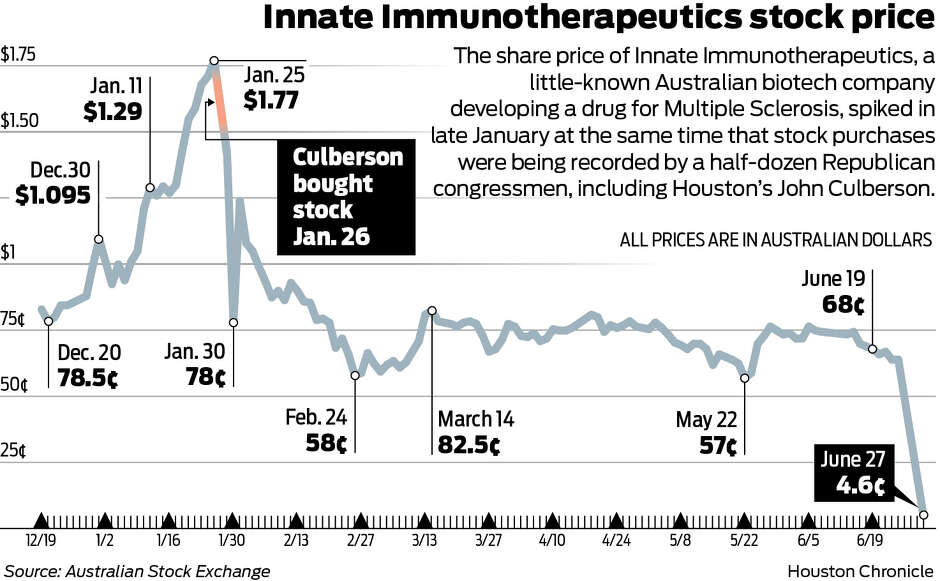
Culberson has declined repeated requests from the Chronicle to talk about the details of his Innate stock purchase, including whether he was still holding on to the stock Tuesday when its price plummeted. He has relied instead on a written statement that his investment was motivated by the death of a family friend from multiple sclerosis. He also acknowledged in a statement that he "rarely" buys or sells stock.
That admission has deepened interest in his decision to buy stock in Innate, a struggling biotech company that generally has been trading for less than $1 on the Australian Stock Exchange.
At least one of the lawmakers, John Culberson of Texas, reported selling his holdings a few weeks before the company was privately informed in June 2017 of negative results from a clinical drug trial. When the news was announced, the company’s share price tanked. He said in a statement Wednesday that he didn’t have any inside information when he sold.
