More to it than you thought. From A Brief History of Slavery and the Origins of American Policing, written by Dr. Victor E. Kappeler. Bold emphasis is mine.

You should also keep in mind that the Second Amendment was ratified in order to preserve the South's slave patrols, whitewashed with use of the word "militias", and specifically to secure the Commonwealth of Virginia's support. And that Texas is one of just seven states in the Union that doesn't allow open carry (yet) because they did not want the slaves shooting back at the guys in white hoods.
So when Joan Walsh points out that the NYPD's racial problems extend back to the '60's, you can now point out to her that it goes back a lot farther than that.
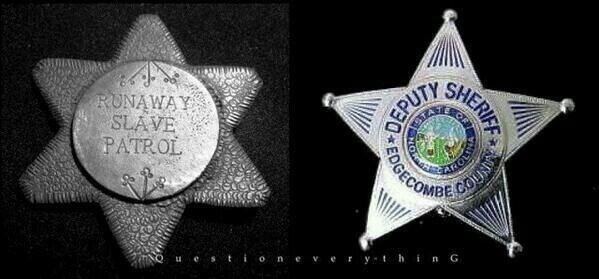
The birth and development of the American police can be traced to a multitude of historical, legal and political-economic conditions. The institution of slavery and the control of minorities, however, were two of the more formidable historic features of American society shaping early policing. Slave patrols and Night Watches, which later became modern police departments, were both designed to control the behaviors of minorities. For example, New England settlers appointed Indian Constables to police Native Americans (National Constable Association, 1995), the St. Louis police were founded to protect residents from Native Americans in that frontier city, and many southern police departments began as slave patrols. In 1704, the colony of Carolina developed the nation's first slave patrol. Slave patrols helped to maintain the economic order and to assist the wealthy landowners in recovering and punishing slaves who essentially were considered property.
Policing was not the only social institution enmeshed in slavery. Slavery was fully institutionalized in the American economic and legal order with laws being enacted at both the state and national divisions of government. Virginia, for example, enacted more than 130 slave statutes between 1689 and 1865. Slavery and the abuse of people of color, however, was not merely a southern affair as many have been taught to believe. Connecticut, New York and other colonies enacted laws to criminalize and control slaves. Congress also passed fugitive Slave Laws, laws allowing the detention and return of escaped slaves, in 1793 and 1850. As Turner, Giacopassi and Vandiver (2006:186) remark, “the literature clearly establishes that a legally sanctioned law enforcement system existed in America before the Civil War for the express purpose of controlling the slave population and protecting the interests of slave owners. The similarities between the slave patrols and modern American policing are too salient to dismiss or ignore. Hence, the slave patrol should be considered a forerunner of modern American law enforcement.”
You should also keep in mind that the Second Amendment was ratified in order to preserve the South's slave patrols, whitewashed with use of the word "militias", and specifically to secure the Commonwealth of Virginia's support. And that Texas is one of just seven states in the Union that doesn't allow open carry (yet) because they did not want the slaves shooting back at the guys in white hoods.
So when Joan Walsh points out that the NYPD's racial problems extend back to the '60's, you can now point out to her that it goes back a lot farther than that.
